
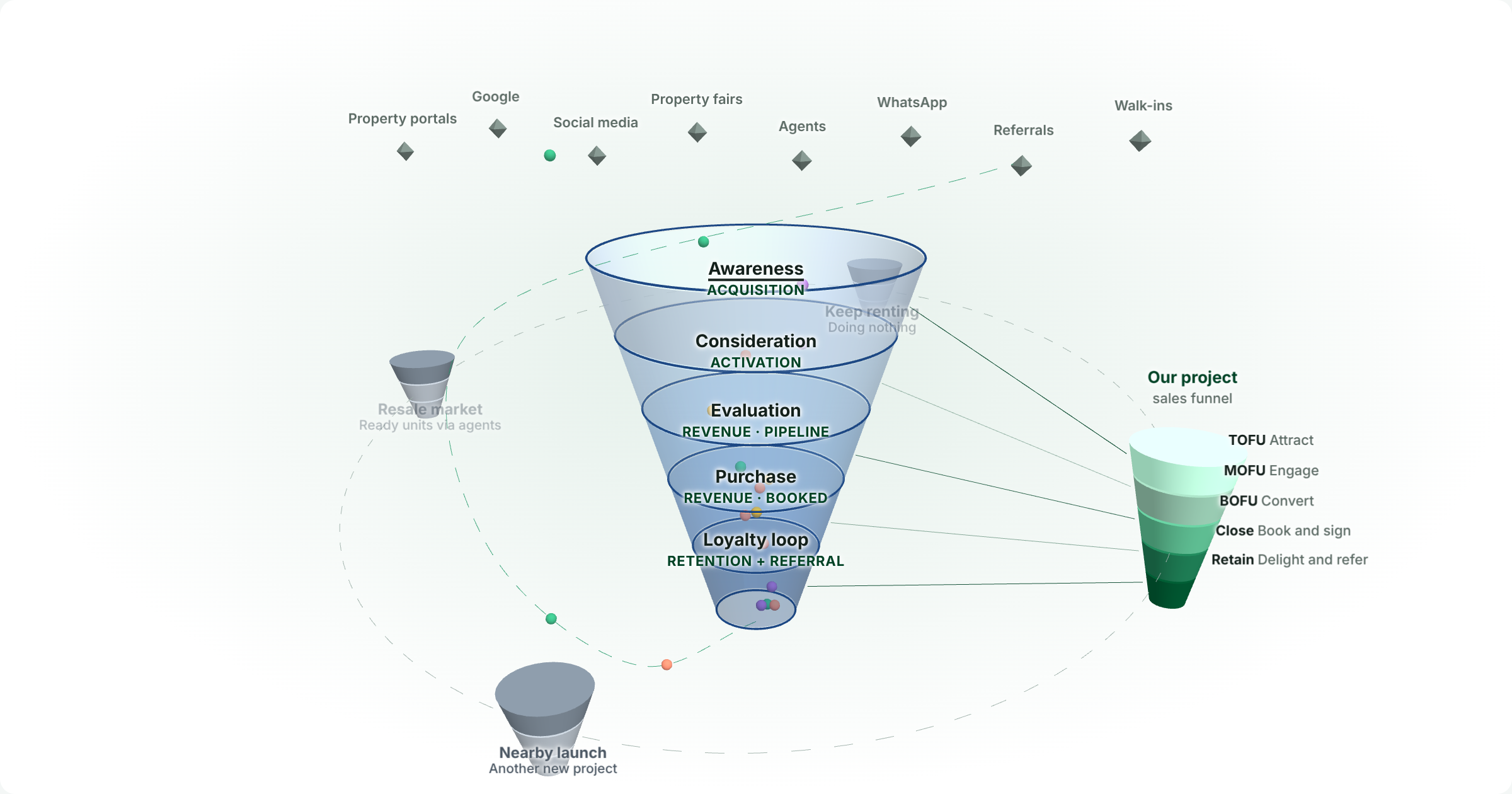

Every business draws a sales funnel, and its buyers never see it. Here’s a simpler way to picture how people actually choose, using someone buying a condo, and why your competitors are working on the same buyer you are.
Start with the buyer, not the funnel
Most marketing plans start with the funnel: top, middle, bottom. That picture describes what we do to the buyer. It doesn’t describe what the buyer is going through.
The buyer is on their own path, called the customer decision journey. They:
- realise they need something
- look around for options
- compare a few
- make a choice
- decide whether they’re happy enough to recommend it, or buy again
Put that journey in the centre of the picture. Your sales funnel moves around it, and so does every competitor’s.
Meet the buyers
Take a new condo project in the city. Four types of buyer might purchase a unit, and each wants something different.
| Buyer | Who they are | What they care about | What worries them |
|---|---|---|---|
| The first-time buyer | A young working couple, renting today | Price, monthly instalment, distance to work and transit | “Will the bank approve our loan?” |
| The upgrader | A family moving from a smaller apartment | Space, schools nearby, facilities for the kids | “Can we sell our current place in time?” |
| The investor | Owns one or two properties already | Rental yield, tenant demand, resale value | “Are there too many units like this nearby?” |
| The family adviser | A parent helping with the down payment | Developer reputation, safety, build quality | “Is this developer reliable?” |
The family adviser often doesn’t sign anything, but can still stop the purchase. A good funnel speaks to them too.
The five stages of the customer decision journey
Here’s how the first-time buyer moves through it.
| Stage | What the buyer is thinking |
|---|---|
| Awareness | “Our rent keeps going up. Maybe it’s time to buy our own place.” |
| Consideration | “Which new projects near our office fit our budget?” |
| Evaluation | “Let’s visit two show units and compare price, layout and the developer.” |
| Purchase | “Pay the booking fee, get the loan approved, sign the agreement.” |
| Loyalty | “Was handover smooth? Would we recommend this developer to friends?” |
How your sales funnel lines up
Your funnel is what you do to meet the buyer at each stage.
| Your funnel | Matches the stage | Your job | Condo example |
|---|---|---|---|
| Top of funnel (TOFU) | Awareness | Be found and be useful | Rent-vs-buy articles, listings on property portals, social media videos of the area |
| Middle of funnel (MOFU) | Consideration | Help them understand the options | Floor plans, price lists, a loan calculator, a virtual tour, fast WhatsApp replies |
| Bottom of funnel (BOFU) | Evaluation | Make it easy to choose you | Show-unit visits, early-bird offers, help with loan pre-approval |
| Close | Purchase | Make buying simple | Clear booking steps, loan and legal paperwork handled for them |
| Retain | Loyalty | Make sure it worked, then ask | Smooth handover, defects fixed quickly, a buyer referral reward |
A funnel works only when it lines up with the stage the buyer is in. An early-bird discount sent to someone who has only started thinking about buying is wasted. So is a general rent-vs-buy article sent to someone standing in your sales gallery.
Your competitors are circling the same buyer
Most funnel diagrams leave this out. You are not the only funnel. Every competitor runs one too, and all of them circle the same buyer at the same time.
For a condo, the competitors are not only other developers:
- The project down the road. Another new launch with a similar price and a bigger marketing budget.
- The resale market. An agent offering a ready-to-move-in unit nearby, with no waiting for construction.
- Doing nothing. Staying in the rental for another year. This is often the strongest competitor of all.
At every stage, some buyers slip away:
- At Awareness, the bigger launch shows up first in search results.
- At Consideration, a resale agent replies faster on WhatsApp.
- At Evaluation, the buyer gets nervous about the loan and decides to keep renting.
So the question is not only “is our funnel working?” It’s “at which stage are we losing buyers, and to whom?”
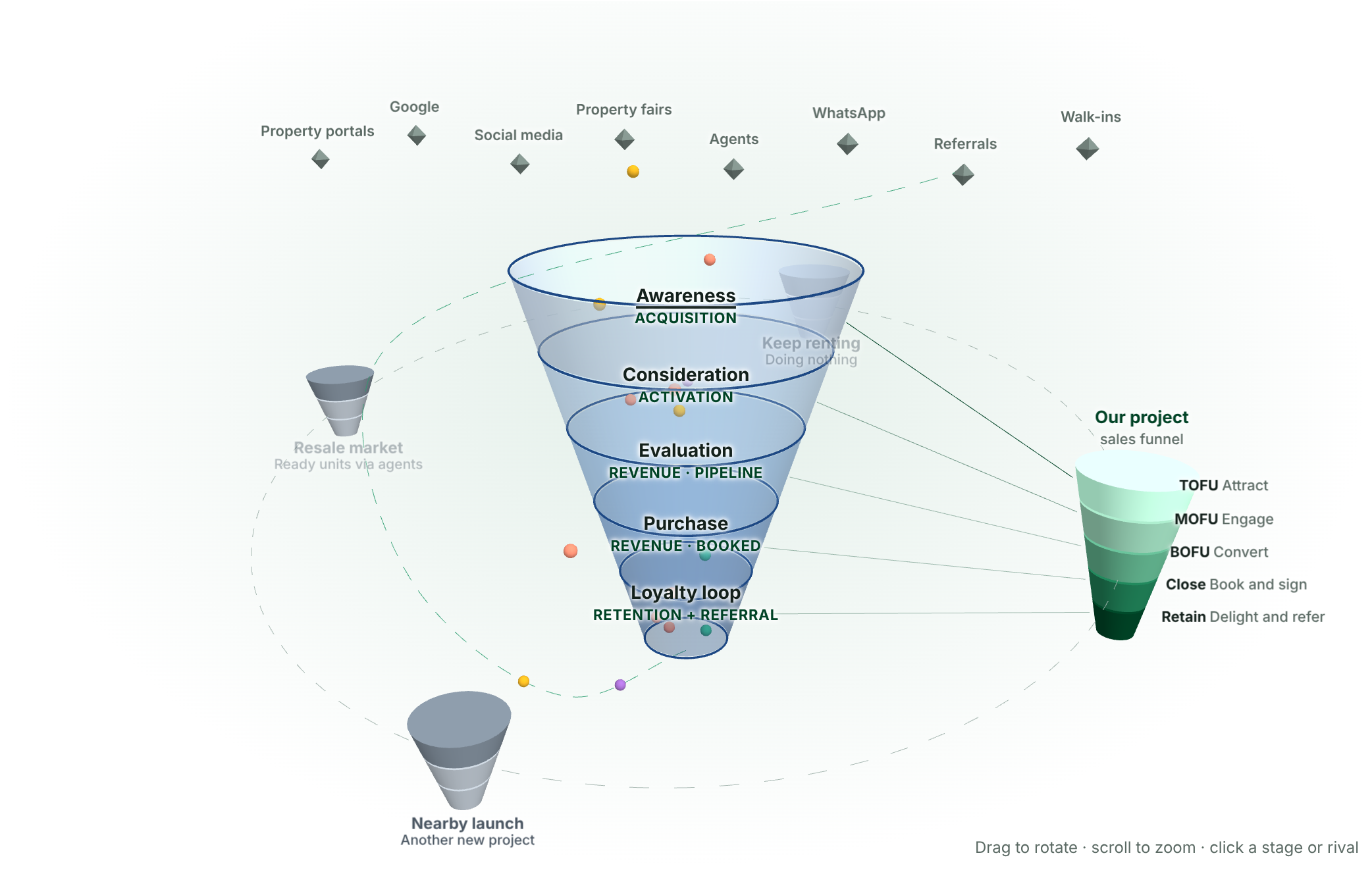
Explore It in 3D
Drag to rotate the model, and click any stage or competitor to see what happens there and what to measure.
Where your buyers come from
Buyers enter the journey through channels. For a condo project these usually include:
- Property portals: the listing websites where most buyers start looking
- Google: search results and paid ads
- Social media: Facebook, Instagram, TikTok and YouTube property reviewers
- Property fairs and roadshows
- Real estate agents
- Referrals: from existing buyers and their families
- Walk-ins: people who visit the sales gallery directly
Each channel brings a different kind of buyer. Investors often come through agents and portals. First-time buyers often come through social media. It’s worth knowing which channels bring people who actually buy, not just people who click.
How to track movement through the journey
A simple framework for this is AARRR, sometimes called the pirate metrics. It gives each stage one main question to measure.
| Stage | AARRR | What to measure for a condo project |
|---|---|---|
| Awareness | Acquisition | Listing views, ad clicks, website visitors by channel |
| Consideration | Activation | Registrations of interest, brochure downloads, WhatsApp enquiries, show-unit appointments |
| Evaluation and Purchase | Revenue | Visit-to-booking rate, bookings, loan approvals, signed sale agreements |
| Loyalty | Retention | Handover satisfaction, time to fix defects, owners who buy a second unit |
| Loyalty, back to Awareness | Referral | New buyers who came from existing owners |
You don’t need expensive tools to start:
- Tag your ad and social links so you know which channel each enquiry came from.
- Record every lead in one place, with its source and which of your buyers it is.
- When a buyer walks away, note where they went: another project, the resale market, or back to renting.
Who does what
Working with the journey takes several roles, and each one owns a different part of it.
| Role | What they own | Where it sits in the journey |
|---|---|---|
| Marketing manager | The marketing plan: which buyers to target, which competitors to beat, budget and targets for each stage | The whole picture |
| Digital marketer | Channels, ads, property portals and tracking: knowing where buyers come from and where they drop out | Awareness to Evaluation, plus the numbers |
| Content marketer | Articles, videos and guides that answer each buyer’s questions at each stage | Awareness, Consideration and Loyalty |
| Sales team | Show-unit visits, bookings and paperwork | Evaluation and Purchase |
When these roles plan together around the same journey, the content matches what the ads promise, and the sales team meets buyers who are already halfway convinced.
Three things to do this month
- Draw your own picture. Put the buyer’s journey in the middle, your funnel beside it, and your main competitors around it.
- Find your biggest leak. Pick the stage where most buyers drop out, and look at who wins them there.
- Track one number per stage. Five numbers are enough to see where buyers are moving and where they get stuck.
The takeaway
Your funnel is your plan for the buyer. The journey is what the buyer actually goes through. Put the buyer in the centre and you’ll see where you meet them, where you miss them, and where a competitor is waiting to step in.
Build these skills with Kognifi
Each part of this framework is covered in a Kognifi course:
- Marketing Plan Training Course (MX-MP): for managers who set the direction and targets.
- Digital Marketing Training Course (MC-DM): for the people who run channels and track movement through the funnel.
- Content Marketing Training Course (MC-CM): for the people who create the content that meets each buyer at each stage.