


Bribery and corruption remain persistent challenges in Malaysia, despite robust legal frameworks aimed at curbing them. These laws not only target public officials but increasingly hold private businesses accountable, building a culture of integrity in commercial dealings.

- Understanding Section 17A of The MACC Act 2009
- Identifying and Mitigating Corruption Risks in The Workplace
- Corporate and Individual Responsibility
As Malaysia strives for economic growth and global competitiveness, understanding these regulations is crucial for companies operating domestically or expanding into the region.
Contact Kognifi Sdn Bhd for tailored anti-corruption training and business advisory services.
Click the button below to contact Kognifi Customer Service (+6010-914 3599) on a working day (Mon-Fri, 9am to 5pm) for your enquiry on training course classes.
Or send in an enquiry form. We will respond within 24 hours on a working day.
Corporate Liability: Section 17A – A Game-Changer for Businesses
A pivotal amendment in 2018 introduced Section 17A, effective June 1, 2020, imposing corporate liability for bribery.
Modeled after the UK’s Bribery Act 2010, it holds commercial organizations (including companies, partnerships, and LLPs operating in Malaysia) vicariously liable if their “associated persons”—employees, agents, or partners—commit bribery to obtain or retain business advantages for the entity.
- Scope: Applies to Malaysian-incorporated firms and foreign entities with a business presence in Malaysia. Even overseas acts by foreign agents can trigger liability if benefiting the organization.
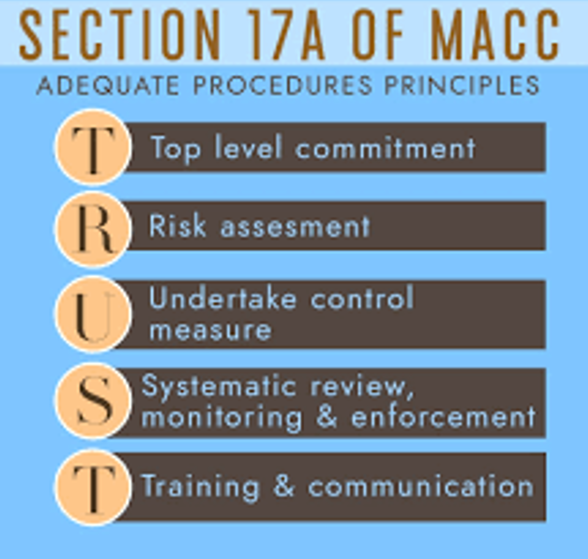
- Defence: Adequate Procedures: Companies can avoid conviction by proving they implemented “adequate procedures” to prevent bribery. The MACC’s 2018 Guidelines on Adequate Procedures outline six principles: top-level commitment, risk assessment, due diligence, communication and training, confidential reporting, and monitoring and review. These align with international standards like ISO 37001 for anti-bribery management systems.
This shift reverses the burden of proof onto businesses, making proactive compliance essential rather than optional.
Master Bribery Laws in Malaysia
1. Why Bribery in Malaysia Demands Your Immediate Focus?
A single bribe could unravel years of hard work, leading to hefty fines, jail time, and irreparable damage to your reputation.
In Malaysia, where economic growth hinges on trust and transparency, bribery remains a stubborn challenge despite stringent laws. As of October 2025, high-profile cases like the ongoing 1MDB saga continue to spotlight the risks, with Malaysia’s Corruption Perceptions Index holding at 50/100—better than some neighbors but far from perfect.
Businesses operating here can’t afford to ignore these threats. Whether you’re a local SME or a multinational expanding into the region, grasping bribery laws isn’t optional; it’s essential for survival and success.
2. How Corruption Issues Commonly Arise in Businesses
For many organisations, the risk of bribery does not always come from obvious misconduct. Instead, it may start with everyday practices that are overlooked or poorly managed.
Common scenarios in Malaysia include:
- Festive gifts and entertainment
- During Hari Raya, Chinese New Year, or Deepavali, lavish hampers, cash vouchers, or expensive dinners may cross the line from customary appreciation to bribery.
- Facilitation payments
- Staff might make unofficial payments to speed up licensing approvals or customs clearance.
- Supplier kickbacks
- Procurement officers may accept commissions or personal benefits in exchange for awarding contracts.
- Third-party risks
- Distributors, sales agents, or consultants may offer bribes without the knowledge of the head office, but liability still falls on the company.
- Charitable donations or sponsorships
- Contributions to events or organisations linked to public officials can create conflicts of interest if not properly vetted.
Left unchecked, these practices can quickly lead to investigations by the Malaysian Anti-Corruption Commission (MACC). For listed companies, Bursa Malaysia also requires disclosure of ABC frameworks and whistleblowing channels in annual reports.
3. Secure Your Business Today
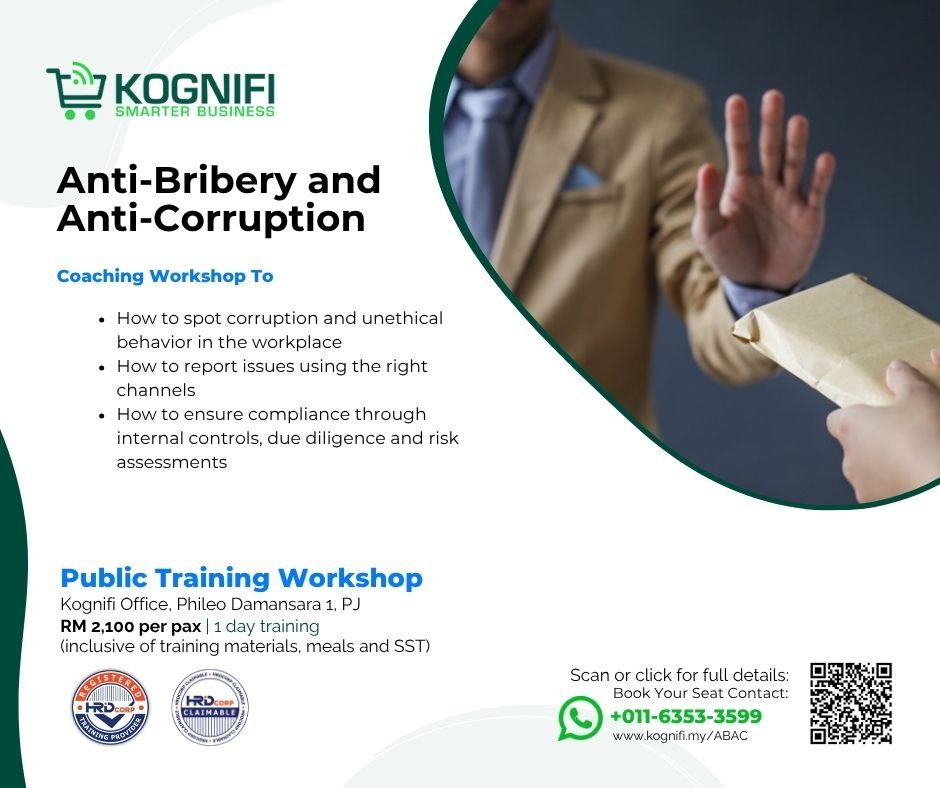
Contact Kognifi Sdn Bhd, Malaysia’s leading digital agency and corporate training provider, for tailored anti-corruption training and business advisory services.
Kognifi Sdn Bhd offers professionally designed Anti-Bribery and Anti-Corruption Training in Malaysia, led by expert trainer Shamini Arumugam, customized specifically for Malaysian businesses.
Table of Contents:
- Module 1 · Legal framework and Compliance – Understanding Section 17A of The MACC Act 2009
- Framework of Malaysian Anti-Corruption Commission (MACC) Act 2009 · Lecture
- Clarification of key terms, including bribery, corruption, conflict of interest, gratification and facilitation payments · Workshop
- Legal penalties, corporate liability and personal consequences arising from violations of the Act · Group Activity
- Module 2 · Identifying and Mitigating Corruption Risks in The Workplace
- Common corruption practices across industries · Lecture
- Detecting corruption and unethical behavior · Workshop
- Whistleblowing and ethical reporting mechanisms · Group Activity
- Module 3 · Corporate and Individual Responsibility – Best Practices for Compliance
- Legal liabilities of organisations and employees · Lecture
- Establishing a zero-tolerance policy · Workshop
- The role of leadership and employee engagement in preventing corruption · Group Activity
Specializing in HRD Corp claimable courses on sales, marketing, and integrity strategies, they can help you implement adequate procedures and stay ahead of the curve.